


.svg)

The integrated project “LIFE-IP AdaptInGR – Boosting the implementation of adaptation policy across Greece” is Greece’s most important project for adapting to the impacts of climate change.
The project aims to strengthen the implementation of the National Adaptation Strategy and the 13 Regional Adaptation Action Plans during the first climate change adaptation cycle (2016–2025), and to prepare the transition to the second adaptation policy cycle (2026 onwards), through appropriate actions at national, regional and local level.
Specifically, it aims to:
- build the capacity of the organisations responsible for implementing climate change adaptation actions and policies;
- establish an effective mechanism for monitoring, evaluating and updating climate change adaptation actions and policies;
- implement demonstration projects in 3 Regions and 5 Municipalities in priority adaptation sectors (flood risk management, coastal zone management, forest fires in drought-prone areas, water resources management, urban planning and urban regeneration);
- inform and raise awareness among citizens and stakeholders;
- mobilise complementary European and national resources and financial instruments for implementing climate change adaptation actions;
- disseminate good practices in Greece, the Eastern Mediterranean and the European Union;
- evaluate and revise the National Adaptation Strategy and the Regional Adaptation Action Plans, preparing the second cycle of adaptation policy implementation (2026 onwards).
LIFE-IP AdaptInGR runs for 8 years (2019–2026) and has a total budget of €14.2 million, of which €8.3 million is provided by the EU, €2.4 million by national resources (Green Fund), €3.2 million by the partners’ own resources and €0.3 million by private bodies (supporters).
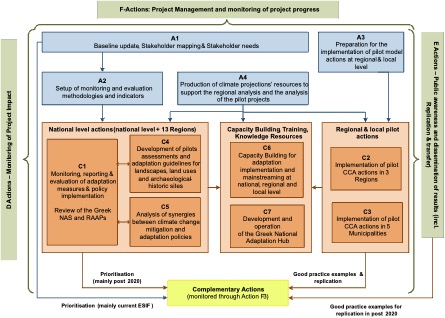
LIFE-IP AdaptInGR is implemented through five groups of actions (A, C, D, E and F). Their synergies and interconnections are summarised in the following diagram.
Group A: Preparatory actions
A.1. Updating the baseline, stakeholder mapping and needs assessment
Action A.1 aims to establish the baseline (starting point) of LIFE-IP AdaptInGR. It will analyse and assess the implementation of the National Adaptation Strategy and the Regional Adaptation Action Plans, and the overall progress made towards climate change adaptation in Greece.
In addition, the main stakeholders involved in planning and implementing adaptation actions and policies at national and regional level will be mapped, and their needs identified through questionnaires and individual interviews.
The results of Action A.1 will feed into Actions C.1, C.6, C.7, D.1, D.3, E.1 and E.2.
Action A.1 coordinator: Ministry of Environment and Energy
A.2. Development of monitoring and evaluation methods and indicators
Action A.2 analyses climate change adaptation monitoring and evaluation practices in the EU and internationally, and develops an integrated monitoring and evaluation framework for Greece. This framework will comprise:
- a system of indicators to monitor progress against the expected results of implementing the National Adaptation Strategy and the Regional Adaptation Action Plans, and against the baseline established under Action A.1;
- an evaluation mechanism to capture overall progress, taking into account the wider benefits and impacts of implementing the National Adaptation Strategy and the Regional Adaptation Action Plans.
Action A.2 coordinator: National Technical University of Athens
A.3. Preparation for pilot applications at regional and local level
Action A.3 prepares the pilot applications (demonstration projects) under Actions C.2 and C.3. It covers 12 pilot applications in five priority adaptation sectors: flood risk management, coastal zone management, forest fires in drought-prone areas, water resources management, urban planning and urban regeneration.
Specifically, Action A.3 includes:
- preparing Sustainable Energy and Climate Action Plans under the Covenant of Mayors for the Municipalities of Agioi Anargyroi–Kamatero, Katerini and Rhodes;
- preparing guidance on incorporating climate risk and prioritising green infrastructure and nature-based approaches in pilot applications and in the technical specifications for their design and/or construction contracts;
- preparing a water resources management study for the Aigeiros Municipal Unit of the Municipality of Komotini;
- preparing tender documents for the design and/or construction contracts of the pilot applications;
- preparing detailed plans for designing and implementing the pilot applications.
Action A.3 coordinator: National Technical University of Athens
A.4. Production of climate projection data to support climate change impact analysis at regional and local level
Action A.4 will produce climate data at a spatial resolution of 12 km² for each of Greece’s 13 Regions, and at a higher resolution (1–3 km²) for the pilot areas of Actions C.2, C.3 and C.4.
Regional climate models (RCMs) from CORDEX, Med-CORDEX and the Copernicus Climate Change Service (C3S) will be used. Changes in key climate parameters (temperature, precipitation, relative humidity, cloud cover, incoming solar radiation and wind speed) between the present and future climate (2021–2100) will be calculated under the RCP2.6, RCP4.5 and RCP8.5 emissions scenarios. Changes will also be calculated for indices relating to temperature and precipitation extremes, the health-related Humidex and PET indices, the forest fire-related FWI index, and other climate indices.
The data and climate maps produced will feed into Actions C.1, C.2, C.3 and C.4. They will also be available as an open geospatial database through the online information hub developed under Action C.7.
Action A.4 coordinator: National Observatory of Athens
Group C: Main actions
C.1. Monitoring and evaluation of climate change adaptation policies in Greece – Revision of the National Adaptation Strategy and Regional Adaptation Action Plans
Action C.1 will implement the integrated framework developed under Action A.2 for monitoring and evaluating the National Adaptation Strategy and the Regional Adaptation Action Plans. Two monitoring and evaluation cycles (June 2020–June 2022 and July 2022–December 2024) will enable the timely identification and resolution of problems, better prioritisation of measures, and recommendations on funding priorities for the Partnership Agreement and the Green Fund. These cycles will also allow the functionality, applicability and effectiveness of the monitoring and evaluation framework itself to be assessed and improved.
Action C.1 will also update the study “The environmental, economic and social impacts of climate change in Greece” (2011), prepared by the Bank of Greece’s interdisciplinary Climate Change Impacts Study Committee, which underpinned the National Adaptation Strategy. The update will take into account the climate projections from Action A.4 and new scientific studies and evidence.
The updated impact study and the results of the two monitoring and evaluation cycles will inform the evaluation report and revision study for the National Adaptation Strategy, and facilitate guidance for evaluating and revising the 13 Regional Adaptation Action Plans.
Action C.1 coordinator: Ministry of Environment and Energy
C.2. Implementation of climate change adaptation pilot applications in 3 Regions
Action C.2 implements pilot applications (demonstration projects) in four priority adaptation sectors in the Regions of Western Greece, the Ionian Islands and Central Greece. Specifically, it includes:
- conducting tender procedures for design and/or construction contracts, using the documents prepared under Action A.3;
- preparing studies for implementing the pilot applications;
- selecting the measures and works recommended by the studies for implementation under LIFE-IP AdaptInGR, and seeking complementary funding for the remaining measures and works;
- organising and hosting visits to the demonstration projects.
Pilot applications (demonstration projects)
Flood risk management:
- Delineation of the Inachos River in the Regional Unit of Aitoloakarnania (Region of Western Greece).
- Flood protection at Drimatorema in the Lianokladi area of the Regional Unit of Fthiotida (Region of Central Greece).
- Channel works on the Sarantaporos stream at Amarynthos beach, Evia (Region of Central Greece).
Coastal zone management:
- Assessment, monitoring and recording of coastal erosion in the Ionian Islands using unmanned aerial vehicles (drones) (Region of the Ionian Islands).
- Coastal zone management at Kalamaki beach, Western Achaia (Region of Western Greece).
Forest fires in drought-prone areas:
- Forest fire prevention in the local communities of Peristeri and Geraki, Municipality of Ilida (Region of Western Greece).
Water resources management:
- Cleaning the drainage system of the drained Lake Xyniada (Region of Central Greece).
Action C.2 coordinator: National Technical University of Athens
C.3. Implementation of climate change adaptation pilot actions in 5 Municipalities
Action C.3 implements pilot applications (demonstration projects) in three priority adaptation sectors in the Municipalities of Agioi Anargyroi–Kamatero, Katerini, Komotini (DEYAK), Larissa and Rhodes. Specifically, it includes:
- conducting tender procedures for design and/or construction contracts, using the documents prepared under Action A.3;
- preparing studies for implementing the pilot applications;
- selecting the measures and works recommended by the studies for implementation under LIFE-IP AdaptInGR, and seeking complementary funding for the remaining measures and works;
- organising and hosting visits to the demonstration projects.
Action C.3 coordinator: National Technical University of Athens
C.4. Pilot assessments and guidelines for adapting landscapes, land uses, archaeological sites and historic monuments to climate change
Action C.4 will assess climate change impacts in nine landscape and land-use case studies, including two within NATURA 2000 areas, three archaeological sites and two historic settlements, using the climate projection data from Action A.4. It will also assess the effectiveness of measures proposed in the Regional Adaptation Action Plans and recommend new measures. Proposals for the two NATURA 2000 pilot areas will be developed in collaboration with the LIFE-IP 4 NATURA integrated project and incorporated into their management plans.
The assessment results will inform a guide to adapting landscapes and land uses to climate change and a guide to adapting archaeological sites.
Landscape and land-use case studies:
- Pylos–Monemvasia
- Eastern Macedonia and Thrace
- Samothrace
- Ioannina–Zagori–Konitsa
- Delos–Tinos–Rineia
- The Delphi landscape
- Region of Central Greece
- Lakes Vegoritida and Petron: GR1340004 and GR1340007 – NATURA 2000, Region of Western Macedonia
- Protected Area GR3000005 – NATURA 2000, Region of Attica
Pilot archaeological sites and historic settlements:
- Archaeological site of Delphi
- Archaeological site of Delos
- Archaeological site of Mystras
- Traditional settlements of Central Zagori
- Old Town of Corfu
Action C.4 coordinator: ELLINIKI ETAIRIA – Society for the Environment and Cultural Heritage (ELLET)
C.5. Analysis of synergies between mitigation and adaptation policies within the long-term low-emission strategy for 2050
Action C.5 aims to create an integrated planning framework covering all climate policies in Greece. It will analyse synergies between national climate change mitigation and adaptation policies. The results will inform the evaluation of the National Adaptation Strategy (Action C.1) and updates to the National Energy and Climate Plan for 2030 and the long-term national low-carbon strategy for 2050.
Action C.5 coordinator: Natural Environment and Climate Change Agency (NECCA)
C.6. Capacity building for implementing climate change adaptation and mainstreaming it into national, regional and local policies
Action C.6 aims to build the capacity of authorities and organisations that need to understand climate change adaptation and integrate it into the implementation of relevant actions and policies. It will include:
- 13 three-day workshops, one in each Region, designed to provide the necessary knowledge and expertise to elected representatives, public service staff and stakeholder groups involved in implementing adaptation actions and policies at regional level. Where possible, the regional workshops will be combined with the information events under Action E.1.
- 2 national workshops to build the capacity of central government services and public- and private-sector stakeholders. These will include a dedicated session for municipalities, discussing local adaptation projects to promote good practices and examples and share knowledge on adaptation at municipal level.
Action C.6 coordinator: Green Fund
C.7. Development and operation of the national climate change adaptation hub
Action C.7 aims to create an open online climate change adaptation information hub, following the examples of the European Environment Agency’s platform (https://climate-adapt.eea.europa.eu/) and those of other European countries. The hub will provide tools and information to support decisions on adaptation policies, plans, measures and actions, and to inform and raise awareness among citizens and other stakeholder groups with an important role in planning and implementing adaptation measures and actions. It will also disseminate good adaptation practices and provide access to the climate projection data and maps produced under Action A.4.
Action C.7 coordinator: Natural Environment and Climate Change Agency (NECCA)
Group D: Monitoring the project’s impacts
D.1. Monitoring the project’s contribution to implementing the National Adaptation Strategy
Action D.1 monitors the contribution of both the project’s main and complementary actions (Action F.3) to implementing the National Adaptation Strategy and the Regional Adaptation Action Plans. An appropriate indicator system and measurement methodology will be developed and applied. Four monitoring cycles, one for each project phase (2019–2020, 2021–2022, 2023–2024 and 2025–2026), will provide the data and information needed to evaluate the effectiveness of the project and its actions, identify problems early and take timely corrective measures.
Action D.1 coordinator: Ministry of Environment and Energy
D.2. Monitoring the impacts of the project’s pilot applications on climate resilience
Action D.2 monitors the impact of the demonstration projects under Actions C.2 and C.3, and their transfer and replication under Action E.2, on reducing vulnerability and increasing climate resilience in the areas where they are implemented.
Action D.2 coordinator: National Observatory of Athens – NECCA
Group E: Awareness raising and dissemination of results
E.1. Awareness raising and dissemination of results
Action E.1 includes developing educational material for primary and secondary school teachers and students, organising teacher training workshops in all 13 Regions, and organising a nationwide information campaign and school competitions for students. It also includes surveys of awareness of climate change adaptation among citizens and key stakeholder groups, and the design and implementation of targeted awareness-raising activities, such as national conferences and regional information events. Finally, it includes producing communication material (leaflets, posters, newsletters, radio and television spots, etc.) and using appropriate communication channels (website, social media, etc.) to disseminate project results.
Action E.1 coordinator: Ministry of Environment and Energy
E.2. Replication and transfer of project results
Action E.2 aims to replicate and transfer project results in Greece, the EU and the Mediterranean. It draws on the partners’ existing networks and collaborations, particularly the local government networks of the Union of Greek Regions (ENPE) and the Central Union of Municipalities of Greece (KEDE), Greece’s trilateral agreements with Cyprus, Egypt and Israel, and the Ministry of Environment and Energy’s participation in European and international networks, forums and organisations (UN conferences, EU working groups, EIONET, the Union for the Mediterranean, etc.). It also seeks networking and collaboration with other European projects, particularly LIFE projects, national authorities and adaptation initiatives, and the organisation of European thematic workshops alongside major international events.
Particular emphasis is placed on replication and transfer at national level. At least 4 Regions and 10 Municipalities will closely follow the development of the demonstration projects, and activities will promote public–private synergies. Adaptation guides for Municipalities and Regions will also be produced, drawing on the experience and expertise gained through the project.
Action E.2 coordinator: Ministry of Environment and Energy
Group F: Project management and progress monitoring
F.1. Project management
Action F.1 covers the technical and financial management of LIFE-IP AdaptInGR.
Action F.1 coordinator: Ministry of Environment and Energy
F.2. Monitoring project progress
Action F.2 covers monitoring the progress of LIFE-IP AdaptInGR, including reporting to the European Climate, Infrastructure and Environment Executive Agency (CINEA) and external financial audits (Audit Reports). It also includes preparing an After-LIFE Plan.
Action F.2 coordinator: Ministry of Environment and Energy
F.3. Monitoring, planning and mobilisation of complementary funding
Action F.3 covers monitoring, prioritising and mobilising resources that complement LIFE-IP AdaptInGR. These include resources from other financial instruments, such as Regional Operational Programmes, the Operational Programme “Transport Infrastructure, Environment and Sustainable Development”, the Rural Development Programme, the Fisheries and Maritime Operational Programme and programmes from financial institutions, to finance projects and actions contributing to the implementation of the National Adaptation Strategy and the Regional Adaptation Action Plans.
Action F.3 coordinator: Green Fund
Expected results of LIFE-IP AdaptInGR:
- An integrated methodological framework for monitoring and evaluating adaptation progress at regional and national level in the vulnerable sectors covered by the National Adaptation Strategy, including landscapes and land uses.
- Accelerated implementation of the Regional Adaptation Action Plans.
- Guidelines and good practices for climate change adaptation in Regions and Municipalities.
- Improved climate resilience in the 3 Regions and 5 Municipalities participating in the project, particularly in the vulnerable sectors covered by their studies and demonstration projects.
- Guidelines for adapting landscapes, land uses, archaeological sites and historic monuments to climate change.
- Integration of synergies between mitigation and adaptation policies into the revision of the National Adaptation Strategy and updates to the National Energy and Climate Plan for 2030 and the long-term low-carbon strategy for 2050.
- A national online climate change adaptation information hub providing information for citizens and key stakeholder groups.
- Better information and increased awareness among the public and stakeholders.
- Increased knowledge and exchange of experience on climate change adaptation.
- Coordination and more efficient use of European adaptation funding for the 2014–2020 and 2021–2027 programming periods.
- Evaluation and revision of the National Adaptation Strategy, and guidance for evaluating and revising the 13 Regional Adaptation Action Plans.
Expected results of the complementary actions of LIFE-IP AdaptInGR:
- Improved climate resilience in all 13 Regions of Greece through funding for appropriate adaptation projects, with emphasis on the sectors covered by demonstration projects and pilot studies under LIFE-IP AdaptInGR.
Group A: Preparatory actions
A.1. Updating the baseline, stakeholder mapping and needs assessment
A1.D1: Updated baseline for implementation of the National Adaptation Strategy and Regional Adaptation Action Plans (M 6)
A1.D2: Stakeholder mapping report at national and regional level (M 4)
A1.D3: Report on training and capacity-building needs and knowledge gaps at regional level (M 19)
A1.D4: Report on training and capacity-building needs and knowledge gaps at national level (M 24)
A.2. Development of monitoring and evaluation methods and indicators
A2.D1: Analysis of international and European experience in monitoring and evaluating national climate change adaptation strategies and plans (M 6)
A2.D2: Evidence base of methodologies and indicators suitable for monitoring and evaluating adaptation actions in all vulnerable sectors included in the National Adaptation Strategy (M 24)
A2.D3: Quality system for the monitoring and evaluation framework (15 reports on qualitative and quantitative monitoring methodologies and indicators, one per sector) (M 24)
A.3. Preparation for pilot applications at regional and local level
A3.D1: Methodologies for integrating climate risks, green infrastructure and nature-based approaches into the technical specifications of pilot applications (M 6)
A3.D2: Sustainable Energy and Climate Action Plan for the Municipality of Rhodes (M 10)
A3.D3: Sustainable Energy and Climate Action Plan for the Municipality of Agioi Anargyroi–Kamatero (M 10)
A3.D4: Sustainable Energy and Climate Action Plan for the Municipality of Katerini (M 10)
A3.D5: Water resources management study (water supply and demand under different climate scenarios) for the Aigeiros Municipal Unit in Komotini (M 12)
A3.D6: LIFE-IP AdaptInGR plan for designing and implementing pilot applications in the Regions (M 24)
A3.D7: LIFE-IP AdaptInGR plan for designing and implementing pilot applications in the Municipalities (M 24)
A.4. Production of climate projection data to support climate change impact analysis at regional and local level
A4.D1: Geospatial database with datasets and maps for each Region/Municipality under study (M 22)
A4.D2: Geospatial database user manual (M 24)
Group C: Main actions
C.1. Monitoring and evaluation of climate change adaptation policies in Greece – Revision of the National Adaptation Strategy and Regional Adaptation Action Plans
C1.D1: Monitoring report updated with the results of the first monitoring and evaluation cycle (M 42)
C1.D2: Monitoring report updated with the results of the second monitoring and evaluation cycle (M 72)
C1.D3: Updated assessment of climate change impacts and regional and sectoral vulnerability in Greece (M 72)
C1.D4: Report on mainstreaming adaptation into sectoral planning at national level (M 72)
C1.D5: Evaluation report on the Regional Adaptation Action Plans (M 96)
C1.D6: Evaluation of the National Adaptation Strategy (M 96)
C1.D7: Revised National Adaptation Strategy (M 90)
C1.D8: Specifications for revising the Regional Adaptation Action Plans (M 90)
C1.D9: Formal adoption of the revised National Adaptation Strategy (M 96)
C.2. Implementation of climate change adaptation pilot applications in 3 Regions
C2.D1: Report on tender procedures for awarding study contracts (M 34)
C2.D2: Current status and monitoring plan for coastal erosion in the Ionian Islands (M 106)
C2.D3: Forest fire prevention in the local communities of Peristeri and Geraki, Municipality of Ilida (M 50)
C2.D4: Study of channel works on Drimatorema (M 51)
C2.D5: Study of channel works on the Sarantaporos stream (M 51)
C2.D6: Inachos River delineation study (M 60)
C2.D7: Report on complementary funding for regional adaptation projects – The LIFE-IP AdaptInGR experience (M 84)
C2.D8: Report on implementation, demonstration and evaluation of adaptation projects in the LIFE-IP AdaptInGR Regions (M 93)
C.3. Implementation of climate change adaptation pilot applications in 5 Municipalities
C3.D1: Report on municipal contract tender documents (M 34)
C3.D2: Coastal engineering studies for Rhodes (M 54)
C3.D3: Coastal risk analysis and management plan for the coastal zone of Rhodes (M 70)
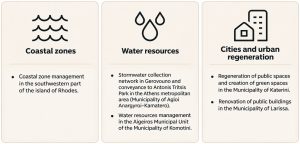
C3.D4: Technical study for developing a model hydraulic system for stormwater management in Gerovouno (M 60)
C3.D5: Technical study on using collected stormwater in Antonis Tritsis Park (M 75)
C3.D6: Report on implementation, demonstration and evaluation of adaptation measures in the LIFE-IP AdaptInGR Municipalities (M 84)
C.4. Pilot assessments and guidelines for adapting landscapes, land uses, archaeological sites and historic monuments to climate change
C4.D1: Nine reports, one per study area, assessing climate change impacts on landscapes and the effectiveness of measures proposed in the Regional Adaptation Action Plans (M 72)
C4.D2: Guide to adapting Greek landscapes to climate change, with recommendations for landscapes of similar typology (M 75)
C4.D3: Recommendations for the technical specifications of Greek spatial plans (local, urban and regional), to facilitate adaptation of land uses and productive activities to climate change (M 84)
C4.D4: Five reports, one per case study, assessing climate change impacts on the monuments and/or cultural heritage sites under study and proposing specific adaptation measures (M 72)
C4.D5: Guidelines for adapting Greece’s historic and archaeological sites to climate change, with recommendations for areas of similar regional and cultural typologies (M 87)
C.5. Analysis of synergies between mitigation and adaptation policies within the long-term low-emission strategy for 2050
C5.D1: Analysis of synergies between the long-term national low-emission strategy for 2050 and the National Adaptation Strategy across all economic sectors (M 72)
C.6. Capacity building for implementing climate change adaptation and mainstreaming it into national, regional and local policies
C6.D1: Capacity-building workshop strategy (M 24)
C6.D2: Supporting material for the first series of regional capacity-building workshops (presentations, layman’s reports from other relevant completed or ongoing projects, etc.) (M 48)
C6.D3: Supporting material for the second series of regional capacity-building workshops (presentations, layman’s reports from other relevant completed or ongoing projects, etc.) (M 72)
C6.D4: Supporting material for national capacity-building workshops (M 93)
C.7. Development and operation of the national climate change adaptation hub
C7.D1: Implementation study and technical specifications for the national adaptation hub (M 12)
C7.D2: Operational prototype of the national adaptation hub (M 30)
C7.D3: System documentation for the national adaptation hub (M 30)
C7.D4: Report on the beta version of the national adaptation hub (M 40)
C7.D5: Report on the second version of the national adaptation hub (M 60)
C7.D6: Report on the final version of the national adaptation hub (M 72)
C7.D7: Evaluation report on the operation of the hub’s services (M 96)
Group D: Monitoring the project’s impacts
D.1. Monitoring the project’s contribution to implementing the National Adaptation Strategy
D1.D1: Monitoring protocol (M 6)
D1.D2: First evaluation of the impact of LIFE-IP AdaptInGR (M 24)
D1.D3: Second evaluation of the impact of LIFE-IP AdaptInGR (M 48)
D1.D4: Third evaluation of the impact of LIFE-IP AdaptInGR (M 72)
D1.D5: Final evaluation of the impact of LIFE-IP AdaptInGR (M 96)
D.2. Monitoring the impacts of the project’s pilot applications on climate resilience
D2.D1: Protocol for monitoring the impact of LIFE-IP AdaptInGR pilot actions
D2.D2: First report on the impact of LIFE-IP AdaptInGR pilot actions (M 48)
D2.D3: Final report on the impact of LIFE-IP AdaptInGR pilot actions (M 72)
Group E: Awareness raising and dissemination of results
E.1. Awareness raising and dissemination of results
E1.D1: Communication and dissemination strategy and action plan (M 6)
E1.D2: Report on the first round of the public opinion survey (M 6)
E1.D3: Report on the second round of the public opinion survey (M 50)
E1.D4: Report on the first round of the stakeholder survey (M 6)
E1.D5: Report on the second round of the stakeholder survey (M 48)
E1.D6: Report on the third round of the stakeholder survey (M 72)
E1.D7: Report on the fourth round of the stakeholder survey (M 96)
E1.D8: LIFE-IP AdaptInGR leaflet (Greek and English) (M 3)
E1.D9: Four LIFE-IP AdaptInGR banners (M 6)
E1.D10: LIFE-IP AdaptInGR radio spot (M 27)
E1.D11: LIFE-IP AdaptInGR television spot (M 27)
E1.D12: Collection of LIFE-IP AdaptInGR newsletters and press releases (M 96)
E1.D13: LIFE-IP AdaptInGR leaflets (Greek and English) (M 96)
E1.D14: Report on the first series of regional information events (M 48)
E1.D15: Report on the second series of regional information events (M 72)
E1.D16: Guidelines and material for training teachers on climate change – Electronic publication (M 6)
E1.D17: “Youth Adapts” material for students (M 24)
E1.D18: Report on teacher training workshops (M 72)
E1.D19: Report on the “Youth Adapts” educational programme (M 96)
E1.D20: Report on school competitions (M 96)
E1.D21: Proceedings of the first LIFE-IP AdaptInGR conference (M 9)
E1.D22: Proceedings of the second LIFE-IP AdaptInGR conference (M 52)
E1.D23: Proceedings of the third LIFE-IP AdaptInGR conference (M 96)
E1.D24: Layman’s report (M 96)
E.2. Replication and transfer of project results
E2.D1: First report on networking activities (M 48)
E2.D2: Second report on networking activities (M 96)
E2.D3: Replication and transfer strategy (M 24)
E2.D4: Good-practice guide to regional adaptation projects, based on the LIFE-IP AdaptInGR experience (M 60)
E2.D5: Adaptation action guide for Municipalities (M 60)
E2.D6: First report on stakeholder activities (M 48)
E2.D7: Second report on stakeholder activities (M 96)
E2.D8: Proceedings of thematic workshops (M 96)
Group F: Project management and progress monitoring
F.1. Project management
F1.D1: Project management protocol (M 2)
F1.D2: Scientific Advisory Committee operating plan (M 2)
F1.D3: Pilot Coordination Team operating plan (M 2)
F1.D4: Dissemination and Communication Strategy Team operating plan (M 2)
F1.D5: Practical guide to public procurement procedures (M 8)
F1.D6: Green public procurement guide (M 10)
F.2. Monitoring project progress
F2.D1: Project monitoring protocol (M 2)
F2.D2: After-LIFE Plan (M 96)
F2.D3: Audit reports (M 24, M 48, M 72 and M 96)
F.3. Monitoring, planning and mobilisation of complementary funding
F3.D1: Complementary Funding Committee operating plan (M 3)
F3.D2: Three complementary funding newsletters – Phase I (M 6, M 12, M 18)
F3.D3: First complementary funding report (M 24, 48, 72 and 96)
F3.D4: Three complementary funding newsletters – Phase II
F3.D5: Second complementary funding report
F3.D6: Three complementary funding newsletters – Phase III
F3.D7: Third complementary funding report
F3.D8: Three complementary funding newsletters – Phase IV
F3.D9: Fourth complementary funding report

The LIFE Programme is the European Union’s funding instrument for the environment and climate change. It aims to contribute to the implementation, updating and development of European environmental and climate policy and legislation by co-financing projects with European added value.
Eligible beneficiaries include public bodies, non-governmental organisations, universities and private companies. The coordinating beneficiary must be based in the EU, while associated beneficiaries may, under certain conditions, be based in non-EU countries.
For the 2014–2020 funding period, the LIFE Programme established two sub-programmes with a budget of €3.46 billion:
The Environment sub-programme covers three priority areas:
- Environment and Resource Efficiency (demonstration and pilot projects);
- Nature and Biodiversity (best-practice, demonstration and pilot projects);
- Environmental Governance and Information (information, awareness-raising and dissemination projects).
The Climate Action sub-programme covers three priority areas:
- Climate Change Mitigation (best-practice, demonstration and pilot projects);
- Climate Change Adaptation (best-practice, demonstration and pilot projects);
- Climate Governance and Information (information, awareness-raising and dissemination projects).
LIFE Integrated Projects are a specific category of projects implementing environmental or climate plans or strategies required by specific European environmental or climate legislation on a large territorial scale (regional, multi-regional, national or transnational). These projects must ensure stakeholder involvement and promote the coordination and mobilisation of at least one additional relevant European, national or private funding source.
Integrated Projects aim at the full implementation of a plan or strategy by including actions that facilitate implementation and mobilise complementary funding, leading to full implementation in due course.
From the launch of the LIFE Programme up to 2018, a total of 254 LIFE projects with a Greek coordinator had been funded. Two were LIFE Integrated Projects: LIFE-IP 4Natura, concerning implementation of the Prioritised Action Framework for the Natura 2000 network in Greece, and LIFE-IP AdaptInGR, concerning implementation of the National Adaptation Strategy.
Ministry of Environment and Energy
General Directorate of Environmental Policy
Directorate of Climate Change and Air Quality
Climate Change Department
Address: 147 Patision Street, 112 51 Athens, Greece
Tel.: +30 210 8642118, +30 210 8646939
Email: adapt@prv.ypeka.gr